
Reading time: 07:58 min
AI is Designing Everything
A Few Words to Begin With
I had planned a different article for today, but recently, I had the pleasure of participating in the Umiejętność Jutra AI program, organized by SGH and Google, and successfully completed it. As you can easily guess, the program showcased the possibilities of using AI in business. The course prompted me to reflect on the application of artificial intelligence in design and art.
I am also aware that the art world, especially digital art, is highly skeptical of AI, but the problem lies in a completely different place than it might seem at first glance.
I invite you to read my thoughts – will AI replace designers and artists? A brief analysis in 4 steps.
Step One: Let's Look for the Advantages of AI
Does AI have advantages in design? Can it bring something positive to the creative process?
In my opinion, the answer to these questions is yes. I would focus on two aspects:
- Increased Creativity and Personalization
- Efficiency and Savings
Increased Creativity and Personalization
Perhaps now you will ask: "How so, greater creativity? After all, AI only outputs what we ask for, and it is often of dubious quality." Seemingly, it might appear that way, but have you ever participated in a brainstorming session? Its main principle is that no idea is bad and each is worth considering. Brainstorming requires several people, but what to do when you are a solo designer and artist, and a blank canvas is daunting?
This is where AI comes to the rescue, with which you can conduct such a brainstorming session. Even if AI's responses seem strange or cliché, it still speeds up the iteration of ideas and allows you to reach something new faster. Thus, it can suggest an idea that you had not previously considered. Thanks to this, there is no longer a blank canvas, but a list of ideas on how to present a given topic.
I personally prefer language models like ChatGPT or Gemini because they do not impose a visual form. However, for some, using generative models such as Midjourney may be a good idea. They present ideas visually, which can lead to the discovery of interesting color combinations or unusual forms.
Efficiency and Savings
In the previous section, I already showed how collaboration with AI can improve efficiency and save time through brainstorming with a virtual assistant. However, this is not the only area where AI brings efficiency to the design process. Many repetitive tasks in design can be accelerated thanks to artificial intelligence.
Take photo retouching, for example. The simplest background removal used to require laborious work with layers and channels to cut out an object from the background. And when it came to a person with a lush hairstyle or delicate smoke, the fun was even greater :). That's why programs like Photoshop or Canva have built-in AI tools to solve this problem. Now, instead of figuring out how to cut something out and wasting a day preparing materials for further creative work, just one click is enough. Of course, sometimes something needs to be corrected, but after all, we are designers to realize our vision, not the vision of a computer :).
And that's not all when it comes to saving time. AI can also help in other areas of design, for example, in creating mockups. Sometimes finding the right photo that is best suited to present your design can take a lot of time. Imagine you are designing a new logo for a flower shop and want to show it on a mockup of flowers wrapped in branded paper. Finding a photo that will match your vision – angle of view, lighting, flower shop style – can take a lot of time and searching through photo libraries.
However, using the power of AI, you can simply describe your vision and get a great base for visualizing your project. Thanks to this, you save valuable time that you can spend on refining the project itself, and not on the tedious search for appropriate visual materials.
Step Two: And Where Are the Disadvantages?
Of course, there are disadvantages. In my analysis, I will focus on these issues:
- Challenges related to data, ethics, and law
- Standardization and limitation of human creativity
Challenges Related to Data, Ethics, and Law
Finally, you can grumble a bit, and my Polish soul rejoices ;) As stereotypically said, a Pole looks at the world through gray glasses. Unfortunately, if an AI model is trained on such data, it will repeat it in its results.
An example might be a watch with hands. Regardless of what time you give the AI model to generate, it will almost always show 10:10. Why? Because this time is shown by watches presented in advertisements. This results from psychological tests that have shown that this time is best associated by consumers. Consequently, AI models do not have patterns of a watch photo with a different time, so, based on the data, for them, a watch should always show 10:10.
Of course, this can also lead to more serious distortions, where social groups may be discriminated against or presented in a stereotypical way.
Another problem that is actually behind the rebellion of artists against AI models is the lack of legal regulation of the use of graphics to train models and the question of who actually has the rights to the generated image. Unfortunately, the entire artistic community suffers from this, because thanks to AI, for example, you can impersonate a famous artist and act to their detriment, deceiving clients.
Artists spend years perfecting their craft, and model creators use their works without knowledge, let alone fees, deriving material benefits while omitting the source. This is a very large ethical and legal problem, and until this problem is resolved, it will be difficult to talk about full trust in AI models.
Standardization and Limitation of Human Creativity
The source of the problem, in my opinion, stems from two aspects:
- AI models do not create anything new, they use the data they were trained on, which leads to the creation of a certain characteristic AI style.
- Laziness of people who believe that what they get from AI can be used without any processing or adding their own talent.
As a result, we get cliché designs that have no unique character. If we ask AI to design a logo for a fish farm, it will certainly include a jumping fish and a wave motif. :)
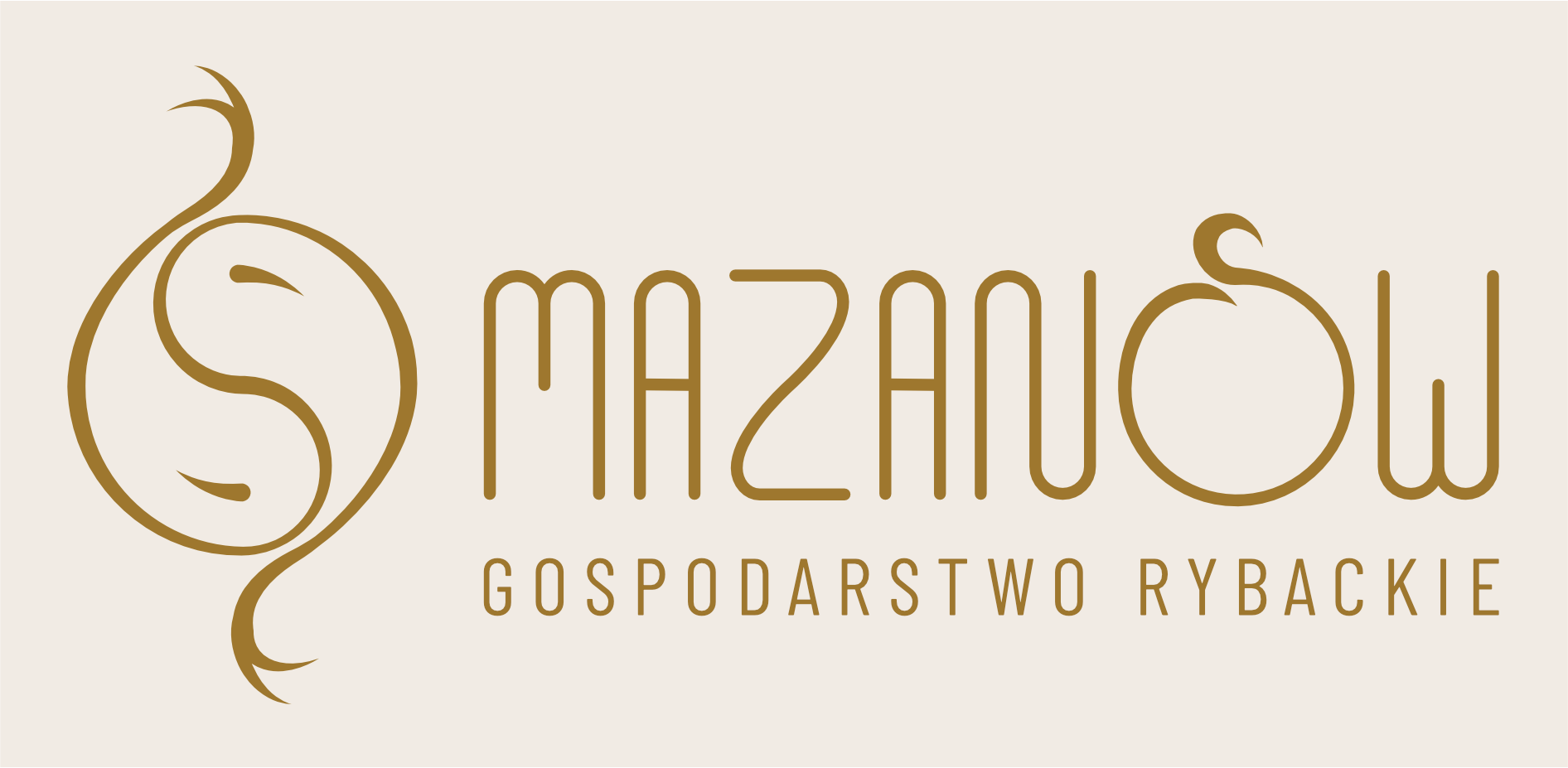
However, I, as a designer, primarily focus on what values a given company has and what it wants to convey to its clients. And so, sticking to fish themes, for my client, Gospodarstwo Rybackie Mazanów, I created a sign that focuses on their values, such as the combination of nature and technology, care for the environment, the connection of feminine and masculine aspects, continuity and multigenerationalism. As a result, a sign was created that clients are proud of and want to wear, because it shows their essence.
Below is the final design, and if you are interested in the whole story behind the sign, visit the Realizations page.
Creating images with AI, we will see that they have a certain characteristic style. And even with longer exposure, we are able to determine whether Midjourney or DALL-E was used. What's more, their "perfection" destroys the aspect of the human soul. In my opinion, pure AI creativity is cold and artificial, where, as Bob Ross said, "happy accidents" are missing, which makes art one-dimensional.
Inspired by the article?
Have thoughts, questions, or want to know how I can help?
Write to me - I'd love to chat!
Step Three: Hope Can Be Found in Everything
Let's look a little into the future now – what positive effects can the development of AI bring to design and art? And this time, I will focus on two aspects:
- Supporting Creativity and New Aesthetics
- Democratization of Design
Supporting Creativity and New Aesthetics
I think that if artists and designers start thinking of AI as another tool in their toolbox, instead of as an enemy, it will allow for the creation of new and unusual works, and perhaps even initiate a new style in art.
Using AI as an assistant to conduct brainstorming and look for non-obvious connections can help create increasingly interesting works. It will also help in the fight against frequent creative block, known as "writer's block".
Because AI gives quick results, it can allow for the exploration of new styles and combinations of elements that would normally not be combined due to fear of wasting time. It can be a gateway for many artists to allow themselves freedom and focus on what they want to convey with their work.
Democratization of Design
I believe that making graphic creation easier for the average internet user, in the long run, can benefit professional artists. Firstly, people will realize that good visual communication still requires knowledge and a pretty AI graphic alone is not enough to convey deeper ideas.
Another plus of the democratization of design is that people will start thinking more in images, which will facilitate communication with artists and designers. It will make it easier to convey their concepts. Which I have already observed working with studios from the game development industry. Where a quick mood board made with AI quickly and efficiently conveyed what the client expects as the final project. Thanks to this, the work of concept artists could focus on precisely fulfilling client expectations.
It also seems to me that AI can replace graphic designers in simple tasks, thanks to which we can spend more time on projects of greater importance and that ignite our passion. My dream is for the world to become more colorful and aesthetic. Facilitating access to creation for a larger group of people can help realize this dream. And thus increase respect for creators who have dedicated many years of work to their craft.
Step Four: Although Where There is Hope, There is Also Risk
In the previous part, I allowed myself optimism and looked at how it could be if everything worked perfectly. Therefore, now let's play the role of devil's advocate and see what risks too much reliance on AI in the areas of art and design entails. Here I will focus on these areas:
- Dehumanization and loss of traditional skills
- Monopolization and unethical use
Dehumanization and Loss of Traditional Skills
Too much reliance on AI may lead to the disappearance of traditional artistic and design skills. People, intoxicated by the speed and ease of creation, may come to the conclusion that they do not need to learn the foundations of design and art, such as composition, typography, perspective, color theory, etc. This will cause them not to understand what and why works, and the computer will not tell them, because, as I mentioned, AI works on the basis of the data provided and does not create original things on its own. As a result, everything will become more mechanical and lacking in that human curiosity.
An additional problem resulting from the disappearance of projects created by people will be that AI will lose the inflow of new solutions. Which will lead to the degeneration of the results obtained. Just like in biology, if we crossbreed a species within related individuals, the risk of diseases and degeneration increases. Similarly, if AI does not have an inflow of new patterns, its results will be less and less satisfactory.
Additionally, giving all creativity into the hands of a computer will make the world mechanical and gray, because for AI, efficiency matters, not emotions. And true art should primarily move human hearts by creating a bond between the creator and the recipient. And for this to happen, creators must know what they are doing. That is why, on this blog and my Instagram page, I want to start sharing my knowledge to inspire new people to explore the knowledge and techniques related to design and art.
Monopolization and Unethical Use
Another risk that I would like to elaborate on is the monopolization of the AI market. The most effective models are in the hands of large corporations that can control access to these tools. This may cause smaller companies or designers not to have access to new technologies, and thus their competitiveness will decrease. This, in turn, can have serious consequences for young artists who often start their careers in smaller companies or as freelancers. This may lead to young artists having an even more difficult start in their careers, because basic things will be done by AI.
Additionally, this will lead to further violations in matters of privacy and copyright. The development of AI in design is associated with the use of huge data sets (images, styles, user preferences), which are often collected and used unethically and without the consent of authors or owners. AI algorithms can be trained on copyrighted data without obtaining licenses or fees, violating the rights of creators. User data may be collected and used without their informed consent and control, violating privacy and individual autonomy.
Currently, with AI, we can already create avatars of any person, whether living or deceased. Combining this with voice copying technology, it is possible to impersonate any person. Therefore, it is so important to ethically use this powerful technology and properly limit it by law, so that it serves good and does not deceive people and lead to their downfall.
So, How Is It Actually with This AI?
We have reached the end of my brief analysis. I realize that this is really just the tip of the iceberg, and if I wanted to develop each topic, more than one book could be written. For sure, for some it will be too optimistic an analysis, and for others too pessimistic, but I tried to show the issue of AI in design and art from as many sides as possible.
But okay, so what is the conclusion from all this? :)
Personally, I want to believe and look optimistically into the future. I believe that AI will help create better and faster, and thus approach design problems more creatively. I currently use text models for brainstorming and searching for interesting and unusual combinations that could better serve my clients.
Despite this, we must constantly remember that AI is just another tool and will not replace humans. Therefore, we should constantly develop ourselves, learn the basics, and only after knowing them, start to transcend them. Let's not look for shortcuts, because it leads to unethical use of AI, degeneration of models, and a decrease in the quality of life. Like any tool, it can be used to build a beautiful world or to destroy it. Just like a hammer can be used to build a house or for manipulation. It depends on us how we use it. We should focus on appropriate regulation so that everyone knows where the boundaries are.
For sure, an interesting world awaits us, and I want to help you stay up to date :)
See you soon :D
Your coffee = my inspiration
Every coffee is an energy boost and motivation for me to continue working.
Thanks to your support, I can spend more time creating valuable content for you!
Follow me and stay up-to-date with creative ideas!
Get Inspired – Join the Newsletter!